


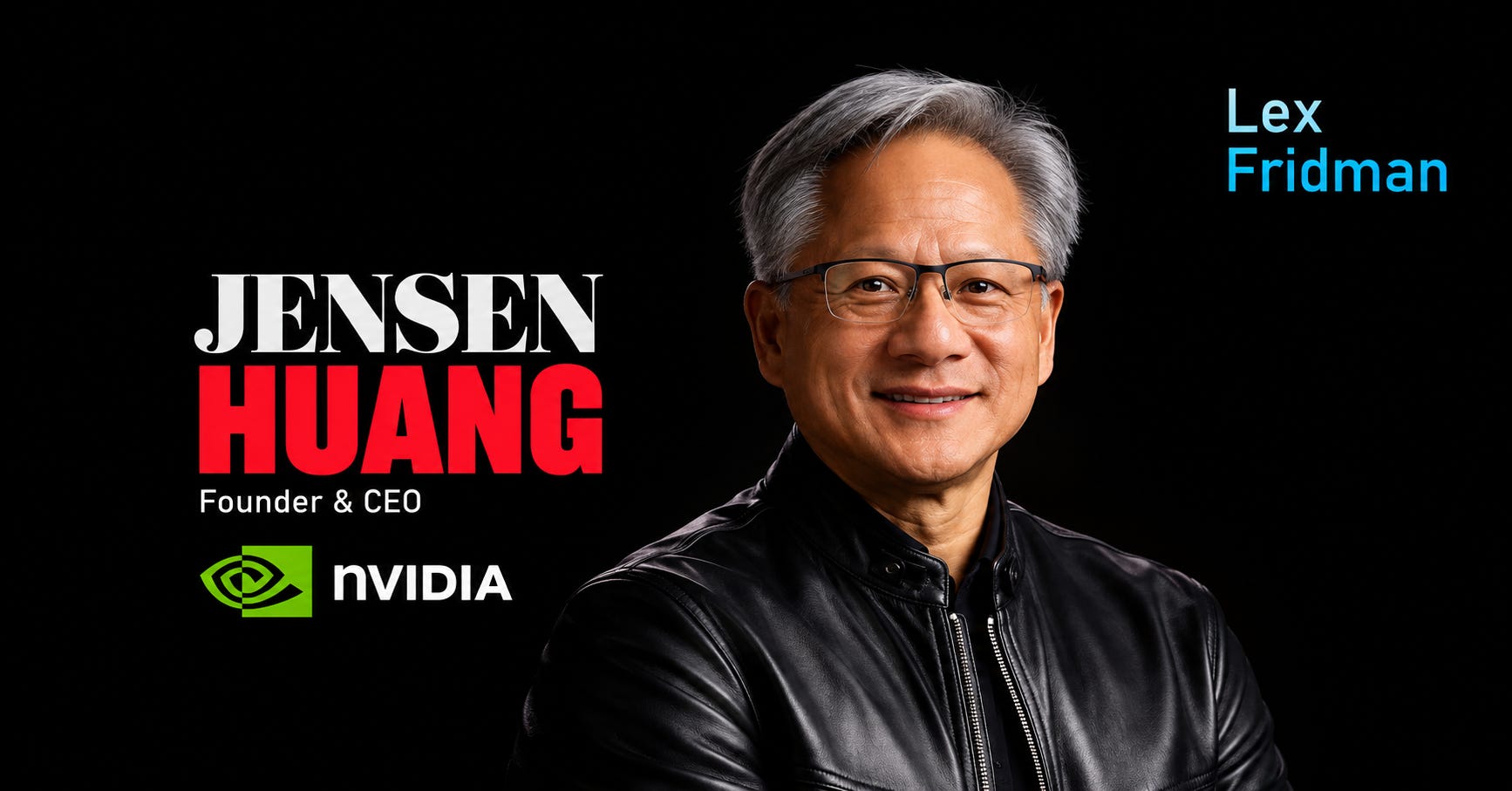
Jensen Huang is the founder and CEO of NVIDIA, which Lex Fridman calls the world’s most valuable company, and he leads 43,000 employees. He grew up in Taiwan and came back for the first time in 30 years when NVIDIA needed a foundry, starting a TSMC partnership that has now run for 3 decades. Fridman spent a few days with him around Computex in Taipei, on an island Fridman says makes more than 90% of the world’s most advanced semiconductors. His through line: NVIDIA does best when its partners win. Between night markets, Huang talks through NVIDIA’s new hardware, how Taiwan built its industry, export controls and how he chooses partners. These signals are from an interview that Lex Fridman did with Jensen Huang on the Lex Fridman podcast.
The Hardware
1. Easy to Build, Easy to Trust. Huang treats ease of assembly as a reliability feature. The new NVIDIA system he showed Fridman at Computex has no cables and no hoses and is 100% liquid cooled, up from 80% in the last generation, Grace Blackwell. Assembly time has fallen from 2 hours to 5 minutes, and Huang confirmed it is in full production. His rule: “Things that are easy to build are also reliable.” ↗ 4:27
2. Tokens, Not Cores. Huang says the economics of the CPU have changed. Hyperscale x86 CPUs were designed to be rented, so the goal was as many cores as possible, priced in dollars per core. AI does not rent cores. It generates tokens and sells them, so the CPU has to move through that loop as fast as it can, and Fridman cites NVIDIA’s Vera CPU at 1.8 times x86. The metric that matters, in Huang’s framing, is tokens generated, not cores rented. ↗ 4:50
The Island
3. Bring the Island Along. Huang aimed his Computex keynote at the supply chain. To build and sell a few trillion dollars of computing in the coming years, he says, the entire island has to be part of it, and every company here must invest hundreds of billions of dollars. He is nervous before every keynote, which has no teleprompter because everything comes together at the last moment. His goal was to make partners understand it, want in and see how they benefit, in as few words as possible. ↗ 9:21
4. Reindustrialize Now. Huang calls the AI boom America’s best chance to invest in the grid, sustainable energy and manufacturing. Demand is so high that companies can afford to manufacture anywhere, so they might as well build in the US, and AI and robotics make this the right moment to bring lost industries back. Taiwan is a strategic partner, sending engineers and money to US fabs because there is not yet enough talent there. His advice to American industry: take the opportunity. ↗ 14:57
5. The Philips Seed. Huang traces Taiwan’s chip industry to a government vision. In the 1950s, K. T. Li set out to bring science and technology manufacturing to the island, and Huang says that vision compelled Morris Chang to come back. Li also attracted Philips, the GE of Europe in Huang’s words. By his recollection, Philips spun off the fab that became TSMC and the equipment business that became ASML. In his telling, that one long-term vision was the beginning of the whole industry. ↗ 16:24
6. The Open Spec. The next break came when IBM opened the specifications for its compatible PC chipsets, from cache and memory controllers to graphics controllers, Huang says. Taiwanese engineers designed those chipsets and had them made at TSMC and UMC, so all kinds of companies could build PCs. A young Michael Dell bought Taiwanese motherboards, licensed Microsoft’s operating system and became a PC maker. In Huang’s account, that open spec is how the PC industry really took off. ↗ 17:43
7. Hiring 3,000 More. NVIDIA has about 1,000 people in Taiwan, Huang says, mostly hardware specialists in supply chain, systems engineering, operations, fab, packaging and test. It plans a new building on the island for 4,000 people, which means hiring another 3,000 once it secures a piece of land. The move matches how he describes the company later in the trip: NVIDIA is built on top of the Taiwan platform. ↗ 26:53
8. Generosity Is the Supply Chain. Huang ties Taiwan’s place in the industry to its culture. After several thousand people lined up to see him on the Computex floor, he said the island’s capacity for generosity and helping others is why its companies sit at the center of the ecosystem and serve as the world’s supply chain. Fridman adds a willingness to work very hard, and Huang agrees it takes both: the generosity, and working super hard. ↗ 35:36
The Flywheel
9. Goodwill Isn’t Zero-Sum. Huang says being looked up to by millions does not weigh on him, because people have always been nice to him and he has always been nice back. At school he hoped every other kid would do well and happily shared his homework. Today, he says, 43,000 NVIDIA employees want him to succeed, and he wants people at other companies to succeed too. His line: goodwill is not a zero-sum game, and “it’s not limited by physics.” ↗ 43:11
10. Optimize the Flywheel. Asked to steelman both sides of export controls, Huang grants that denying others a force multiplier works for physical things like refined rare earths, bullets and bombs. But if the goal is long-term national security, he argues, prosperity is the better path, because the safest countries are the richest and technology and wealth feed each other as a flywheel. His recommendation: be extremely selective about access to certain technologies, and otherwise optimize for the flywheel. ↗ 44:32
11. Reach Funds R&D. America’s flywheel is the best, Huang says, partly because most of the world responds to English, so products built on an American tech stack and standards can deploy almost anywhere. That is not true for China. “Technology without customers is useless,” he says. Flywheels are also delicate: NVIDIA’s took 3 decades to reach a tipping point and could slow quickly. His conclusion is to seek the widest platform reach, because reach creates the wealth that funds R&D. ↗ 51:23
The Foundry
12. Capacity Cost You IP. In the mid-1990s PC boom, everyone from NEC and Toshiba to Hewlett-Packard wanted a foundry, Huang says. In the US, Intel, AMD and TI made only their own chips, and SGS-Thomson turned NVIDIA away. Capacity was so scarce that using a foundry meant licensing your technology to it, while TSMC and UMC offered capacity with no strings attached. Huang sees the same pattern in some early AI deals, where access to capacity means licensing something away. ↗ 1:10:16
13. Write to the Founder. TSMC was then about a $300 million company, Huang says. He found its US number in the Yellow Pages, reached a recording, left messages several times and never heard back. So he wrote Morris Chang a long letter. Much later, around 6 one evening, Chang called while the team outside was playing the first PlayStation. Huang’s reaction: “Maybe we won’t have to die.” Chang invited him to Taiwan, his first trip back in 30 years. ↗ 1:21:02
14. Choose Who, Not What. TSMC and UMC sat across one street, and Huang liked both. He chose TSMC because Morris Chang kept telling him what TSMC could not do, and talked only about governance, integrity, partnership and the long term. Chang promised that if they worked together, TSMC would jump through hoops for NVIDIA, and Huang says it has for 30 years. His lesson: with a foundry you are choosing not what to buy, but who to work with. ↗ 1:23:08
15. Leave Something on the Table. Huang keeps the TSMC relationship deliberately loose, because a contract as specific as an ironclad prenup makes a relationship brittle. The two practice what he calls rough justice: sometimes TSMC wins, sometimes NVIDIA does. Forcing everyone to bid until nobody makes money but you is remembered on the island forever, he says. Last year his supply chain’s stocks rose 300% while NVIDIA’s stayed flat. His rule: always leave something on the table, and think about your partners’ success. ↗ 1:25:42
Watch the full Video Here.