


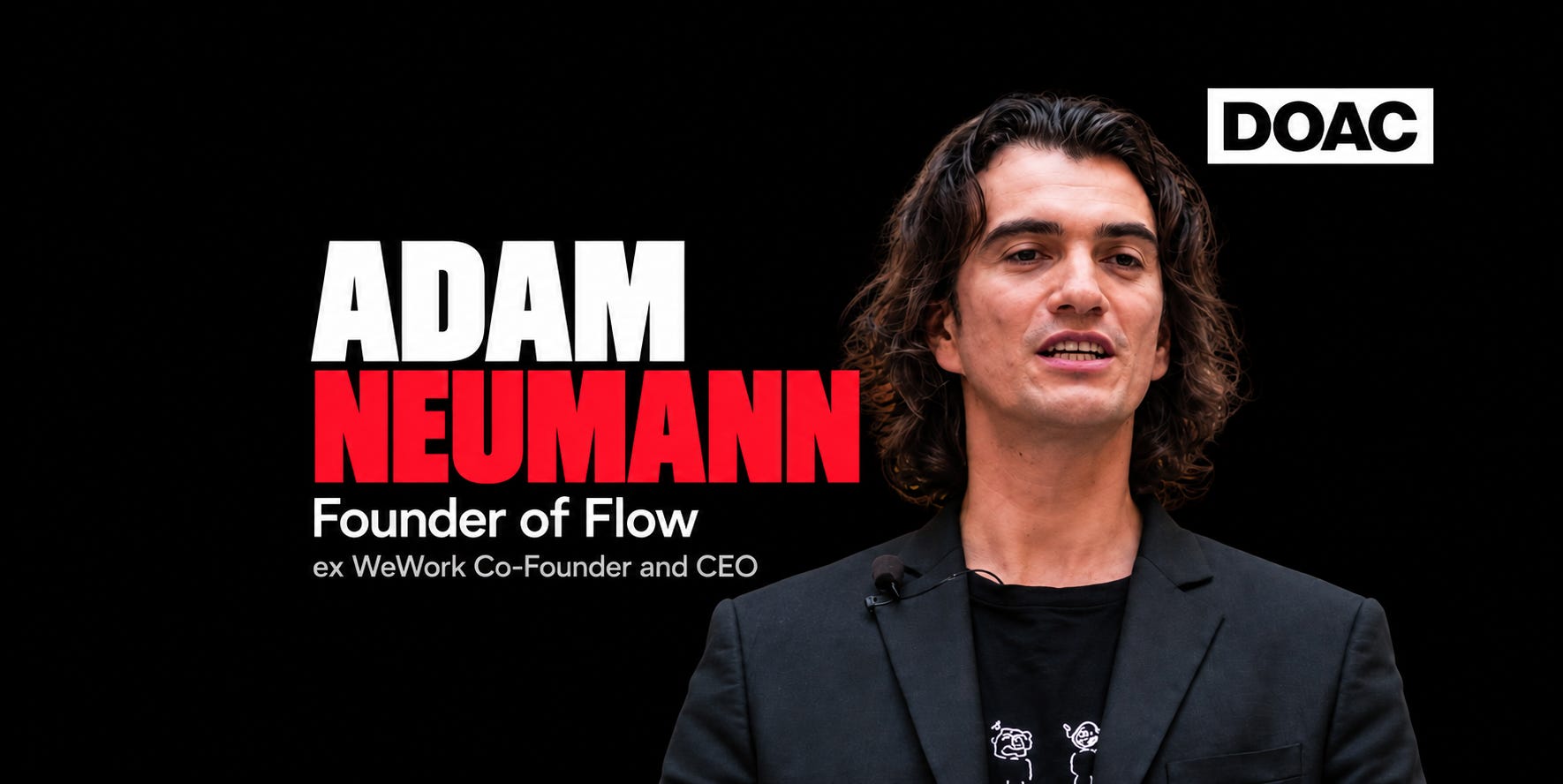
Adam Neumann cofounded WeWork in February 2010 and says that by year 9 it was opening 2 buildings a day across 130 cities. Its August 2019 S-1, Bartlett notes, valued the company at around $47 billion. Later that year he stepped down and, he says, went from 13,000 employees to 3 in a week. He now runs Flow, backed by $470 million from Andreessen Horowitz. He argues he got far more right than wrong at WeWork, but the business outgrew him. The conversation runs from his early money chase to Green Desk, board practice, the SoftBank deals, personal discipline, the failed buyout, his exit and the settlement. These signals are from an interview that Steven Bartlett did with Adam Neumann on the Diary Of A CEO podcast.
The Foundations
Superpower Plus Mission. At 21, Neumann says, he wanted to be a billionaire, believing money would fill the hole left by his childhood. 3 businesses followed, and none succeeded. Rebecca, then his girlfriend, told him chasing money works like chasing cool, and that money caught that way would harm him. Her alternative: connect his superpower to something meaningful for the world, because employees, investors and consumers all want that company, and the money follows. He proposed 3 months after they met. ▶ 20:12
The Green Desk Math. Green Desk, WeWork’s precursor, launched in May 2008 after a pitch to a skeptical landlord. Neumann told the owner, Mr. Gutman, his buildings sat empty and proposed splitting a floor that might rent for $5,000 a month into 15 spaces at $1,000 each. After a $2,500 receptionist, the landlord would get $7,500 and the founders the rest. Gutman offered all 5 floors. 5 Craigslist ads filled it to 92% in a week; within a month it was cash-flow positive, a first for him. ▶ 23:05
The Build
Itemize Every Quote. At WeWork’s second building, Neumann had $90,000 for the build-out against quotes of about $200,000 a floor. When wood floors came in at $30,000 to $45,000, he asked contractors to itemize pieces, nails, glue and labor hours, and none could. He offered the top 3 their costs plus a 15% margin in exchange for full visibility, and all agreed. The first floor cost $12,000, and the contractors later joined WeWork as an in-house construction company. His rule: ask why. ▶ 37:27
Outgrown by the Business. WeWork opened 1 building in its first year and, Neumann says, 2 a day by year 9, each around 100,000 square feet. Many of the same early staff led that pace. For Bartlett’s roughly 200-person company, he suggests sitting 30 staff in a circle so each can name the internal barrier holding them back. His diagnosis: WeWork grew faster than he did. A company that outgrows its founder, he argues, either crashes or leaves the founder unfulfilled. ▶ 41:57
Partners Who Tell the Truth. Asked how to judge hires outside his expertise, Neumann says he picks partners who tell him the truth. Andreessen Horowitz put $470 million into Flow across the Series A and B, and his family $350 million, so both sides buy and sell together. After each all-day board meeting, he asks Marc Andreessen and Ben Horowitz over dinner what he can do better. He vets investors by their history with founders, citing Benchmark, which he says pushed out him, Travis Kalanick and Jack Dorsey. ▶ 50:48
Influence, Not Control. Neumann says that when he has a problem with an employee, the only person to blame is himself, and that he is shifting from top-down to bottom-up leadership. Talented people can always leave, he argues, so a reporting line does not oblige them; they want inspiration, room for mistakes and direct feedback. He warns against sitting on criticism for 90 days to avoid conflict, and says to invite feedback in return. His line: “power comes from influence, not control.” ▶ 53:37
The Deal
Four-Wall Payback. Neumann separates WeWork’s building economics from its consolidated losses. A store or restaurant does well to return its investment in 24 to 36 months; he says WeWork buildings at their peak did it in 6 to 9 months. New sites lose money while they ramp, so a fast-growing city and the P&L look unprofitable, and stopping growth would have let demand fill supply. The real mistake, he says, was signing long-term leases against short-term commitments, which Flow avoids. ▶ 57:55
12 Minutes, $4.2 Billion. The night before meeting SoftBank’s Masayoshi Son in 2016, Neumann’s board agreed to raise $300 million to $400 million, stop growing and go public. Son’s 90 minutes shrank to 12 because he was meeting President-elect Trump; Neumann spent 5 of them texting Jared Kushner to arrange Son’s introduction. In the car, Son dismissed the $400 million, proposed $3 billion, then settled on $4.2 billion, signed on an iPad. Neumann’s advice: before accepting 10 times your plan, ask why, and whether you are ready. ▶ 59:18
Ego Is Desire. Neumann dates WeWork’s decline to the walk from 54th Street back to 18th Street headquarters. With a $20 billion valuation and a stake of about 25%, he tallied his net worth with each step. “Ego and desire are the same word,” he says. A high-growth company makes 100 decisions a day and needs 98 right; a founder blinded by ego slips to 95 or 90. Because WeWork was led from the top, his loss of mission spread to everyone. ▶ 1:08:30
The Discipline
Technology Shabbat. For about 10 years Neumann has kept a 25-hour Shabbat from Friday, and he recommends a secular version to anyone: 24 hours fully off the phone. Put it in a cookie jar or give it to a friend. In the first 2 hours, he predicts, constant reaching for the pocket will reveal the addiction. Bartlett, who first said he saw no upside, agreed to try it in September. Neumann’s promise: some of your best ideas in a while, including who to surround yourself with. ▶ 1:28:34
Creator, Not Protector. Focus is not his superpower, Neumann says; zero to one is. Horowitz’s contrast: another founder brings 9 ideas to a board meeting and executes 1; Neumann brings 9 new businesses. He cites his wife’s grandfather, Andre Herz: “It takes one lion to make a fortune and 10 lions to watch it.” He can run 3 to 5 initiatives, not 10 to 15, so he needs trusted people who say no. After his ego took over, WeWork drew hires who came for the money. ▶ 1:35:24
The Fall
The $20 Billion Holdout. In Neumann’s account, Son offered in March 2018 to buy WeWork for $20 billion in cash, $10 billion to investors and $10 billion to the balance sheet, while the company lost about $2 billion a year. A special committee including the Benchmark board member held out until October, aiming for $32 billion. By December 24, 2018, when documents were ready, SoftBank’s stock had fallen and Son withdrew. Already committed to leases, WeWork was pushed into an IPO it was not ready for. ▶ 1:39:15
Get It in Writing. Neumann says he stepped down by choice, while controlling the board. A head of one of the world’s 2 biggest banks offered $2 billion for WeWork if he became executive chairman, and waved off his $460 million in personal debt, though never in writing. 10 minutes after the board call, the bank cited change of control and gave him 15 days to repay or forfeit his 5-to-1 voting shares, and with them WeWork. His line: “If you’re going to stab the king, kill.” ▶ 1:50:05
The Personal Guarantee. Days later Neumann woke up crying, the first time his wife, Rebecca, had seen him cry. He had agreed to put $100 million in her name and never did, and had signed a personal guarantee he had promised never to sign. She proposed living at her mother’s mortgage-free house upstate, then returning to business or surfing in Costa Rica. That morning he smiled through a meeting with his 3 remaining partners. His lesson: choose a partner for your worst day, not your best. ▶ 1:56:23
Rebecca’s Ultimatum. After Son repaid the $460 million and took control, SoftBank agreed to pay Neumann and other investors $3 billion on April 1, 2020, then invoked force majeure the day before. Litigation ended in a $1.5 billion settlement, $500 million of it to the Neumanns, payable in 2 months. Days before a scheduled C-section, Rebecca refused the delay, since SoftBank had already missed one deadline: pay by Friday 8:00 a.m. or go to court Monday. The money landed at 4:30 a.m., hours before she gave birth. ▶ 2:03:01
Watch the full Podcast Here.