


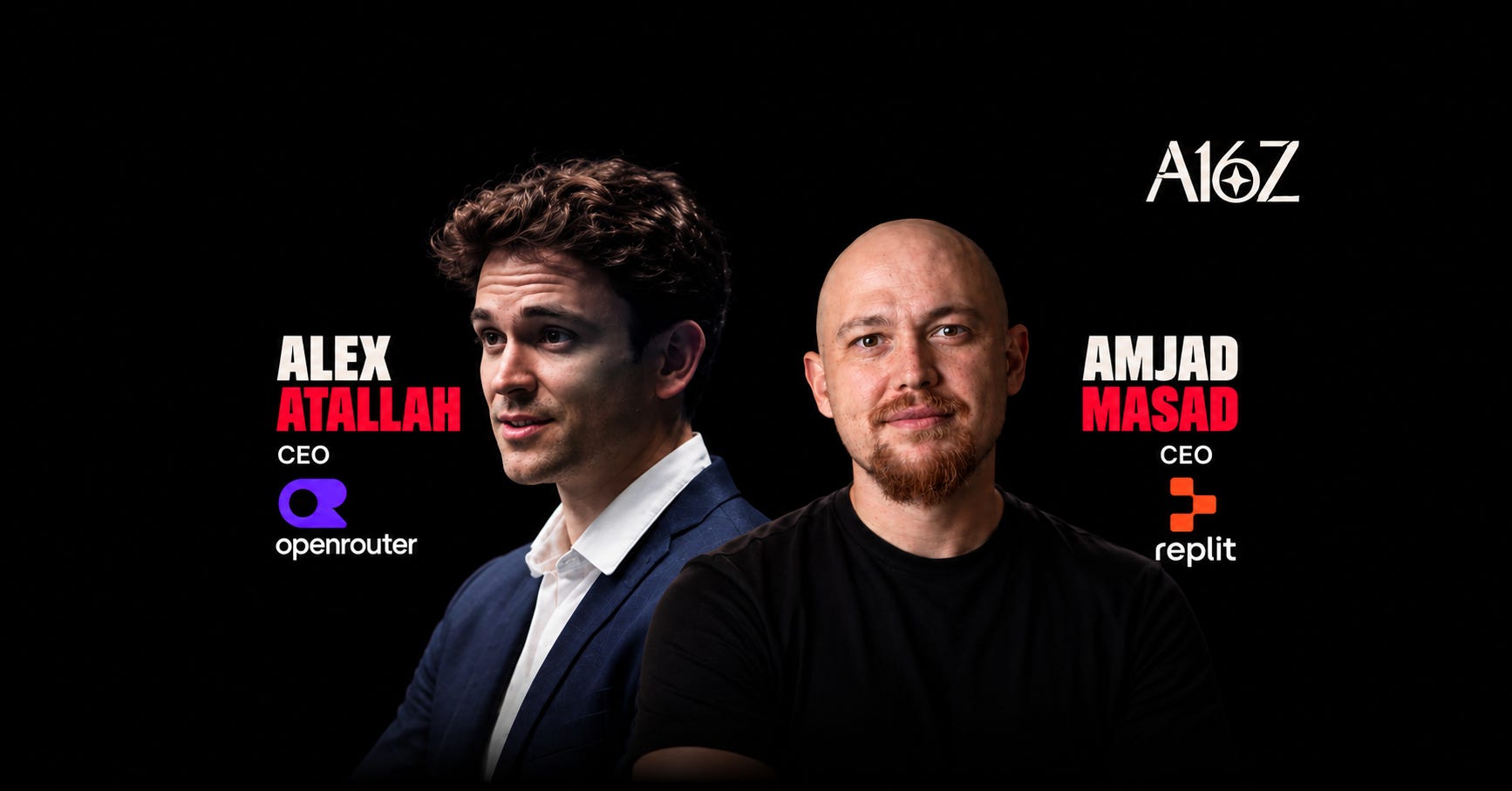
Alex Atallah started OpenRouter 3 years ago. Before it, he says, AI had just one player, OpenAI, and no real marketplace for models. OpenRouter set out to let companies use many models without lock-in, and Stripe has since acquired it. Amjad Masad, an OpenRouter investor alongside a16z, runs Replit and has spent almost a year making it deployable inside customers’ own clouds. Both argue against a single god agent that does everything. They talk through the Stripe deal, why enterprises want to own their intelligence, the case for specialized agents and the economics of small models with Erik Torenberg. These signals are from an interview that Erik Torenberg did with Alex Atallah and Amjad Masad on the a16z podcast.
The Deal
1. Why Stripe Won. Atallah was not thinking about selling. He had talked with Stripe president Will Gaybrick a couple of years earlier, during OpenRouter’s Series A, and the two stayed in touch while OpenRouter ran several projects with Stripe teams. Stripe reached out in July, and talks moved quickly. Stripe was his top choice among possible acquirers, aligned on OpenRouter keeping autonomy over its brand, roadmap and product, with a much more serious go-to-market plan. His line: “payments and inference are going to blend together.” ↗ 1:32
2. Neurodiversity Is the Moat. A company building on AI has to answer a buyer who wonders whether to just use the model directly. Atallah’s answer is neurodiversity: combining models trained in different ways, including your own, to do more on a task than ChatGPT or Claude would alone. OpenRouter also aims to drive down costs by building an efficient market. Some businesses cannot emerge until they become cost-effective, he says, and a provider with a captive market has no reason to lower prices. ↗ 5:33
The Enterprise
3. Enterprises Want Options. Enterprises have been more open to open-weight models than Atallah expected. Instead of buying what other credible enterprises buy, many wanted to diversify beyond the proprietary frontier labs, for cost and for differentiation, and to own their intelligence. Every enterprise now has an internal AI team, he says, and its board asks every month what comes next. He is surprised there has not been more benchmarking, and expects evals to become a bigger focus for those teams. ↗ 9:08
4. The Independence Layer. Masad argues every company needs its own AI practice, the way every company has software engineers, a point he credits to Microsoft’s Satya Nadella. Palantir’s Alex Karp has raised the risk that frontier labs move into partners’ businesses, as Masad says happened with Harvey and OpenAI. The labs want to subsume a big part of the economy: he cites a $30 trillion figure in the SpaceX S-1, against world GDP of about $100 trillion. Replit’s answer is an independence layer across models and clouds. ↗ 12:24
5. Bring Your Own Cloud. Two years ago, Masad says, he would never have let customers run Replit on their own cloud, because software as a service looked like the future. Now companies are more protective, since agents create so many ways for data to leak. Replit spent almost a year making the product deployable on customers’ own clouds. The consumer use of agents is obvious, he says, but making them do real work inside an enterprise is still an unsolved problem. ↗ 16:36
The Agents
6. Agents Carry No Responsibility. Masad likes one agent that joins his chats, GitHub, Salesforce and calendar. Atallah takes the counter. The more work you give an agent, the more understanding you sacrifice, “and yet no one new is taking responsibility.” Each time he improves his own general agent, he ends up ignoring its output about a week later. He would rather have something like 10 chiefs of staff, each responsible for one area, which lets him tune how much understanding he gives up. ↗ 19:53
7. Machines Should Specialize. Masad says the debate rediscovers Adam Smith, for whom specialization was a huge realization for humanity. People then over-specialized, he argues, citing Marx’s theory of alienation, in which workers never see the fruits of their labor and end up feeling like machines. The idea of one god agent may be a reaction to that, he suggests, even though specialization is good for machines. His line: humans should be general, and machines should be specialized. ↗ 23:36
8. Access Control Forces Specialists. No system of specialized agents yet feels as elegant as ChatGPT or Claude, Atallah says. One use case people seemed to like came from Grok bot: one bot for a bank account, another for Twitter, with no shared credentials. Masad adds the enterprise reason. CEOs can run general agents because they have admin access, but individual employees cannot, because of access control. He also wants a DSL or protocol for agent-to-agent communication, so one agent cannot talk another into giving up data. ↗ 25:11
The Risk
9. Guard Every Tool Call. Agents make so many tool calls that checking them takes a cheap, fast model, Atallah says, and OpenRouter runs a small internal prototype along those lines. A decision model reviews each tool call against the agent’s system prompt and against extra guidelines the agent was never told. His example is red-team agents told to act like bad actors, under a hidden rule to stop the moment they reach the internet. He expects companies to combine checks like this with structural safeguards. ↗ 28:36
10. Models Train Their Replacements. Masad says one idea gets little discussion: models training their replacements. He compares it to a just-in-time compiler, which spots a chance to optimize running code and emits faster machine code on the fly. A general model could notice a limited use case and train a domain-specific model on the spot. That model would be cheaper, less vulnerable to prompt injection and less harmful, because it is less capable. Using frontier models for most tasks, he says, is “like nuking a butterfly.” ↗ 31:13
11. Deception Scales Too. Asked by Torenberg whether smarter models are easier to align, Masad says machines may go the other way. The orthogonality thesis holds that intelligence is independent of ethics, and he thinks it does not fully hold for people. In models, though, research on reinforcement learning shows reward hacking and deception getting better. Models can know they are being evaluated, and heavy monitoring of their chain of thought leads them to lie in it. Proper alignment evals, he argues, need to run for months. ↗ 35:23
12. Pay for Risk, Not Size. Asked whether companies would pay 10 times more for a model with no risk of deception, Atallah says it depends on the task. Writing code and security research are the highest-risk tasks today, so there a fully anti-deceptive model that can find all the bugs is probably worth 10 times the cost. Decision models, whose structured outputs are fully controlled, leave much less room for misbehavior. He expects enterprises to get a lot more interested in them. ↗ 38:42
The Payoff
13. Small Models, Less Debt. Masad has been training small models such as Qwen 8B by asking models like Fable and Opus to do the training. One is a cost estimator that tells Replit what a prompt will cost, assigning probabilities to buckets such as $5 to $10 and $10 to $20. With so much data at Replit, he says, specialized classifiers are easy to train. Companies worry that fine-tuned text models must be redone every couple of months, but a bespoke classifier on proprietary data carries less model debt. ↗ 40:53
14. The Rust Cycle. Masad expects AI to repeat a cycle from programming. In the 1990s developers wrote Java and C++, then Python, JavaScript and Ruby took over the internet, with Stripe built on Ruby and Facebook on PHP. Bugs and slowness followed, so teams added types and JIT compilers, and then Rust arrived. He predicts companies will find general models wasteful and risky for many uses. Replit is adding a way to upload a CSV file and get a specialized model that does one thing. ↗ 43:25
15. Fusion at Half the Cost. Code review was the first place Atallah saw people seriously use different model families to double-check a main model, and research on mixing models is now speeding up. OpenRouter launched a fusion model, starting with deep research, on the logic that labs train on different data, so it pulls from all of them. He says it delivered roughly Fable-level quality at half the cost, and Cognition launched one too. Masad says Replit just published frontier-level results at 40% to 50% of the cost. ↗ 45:12
Watch the full Video Here.