


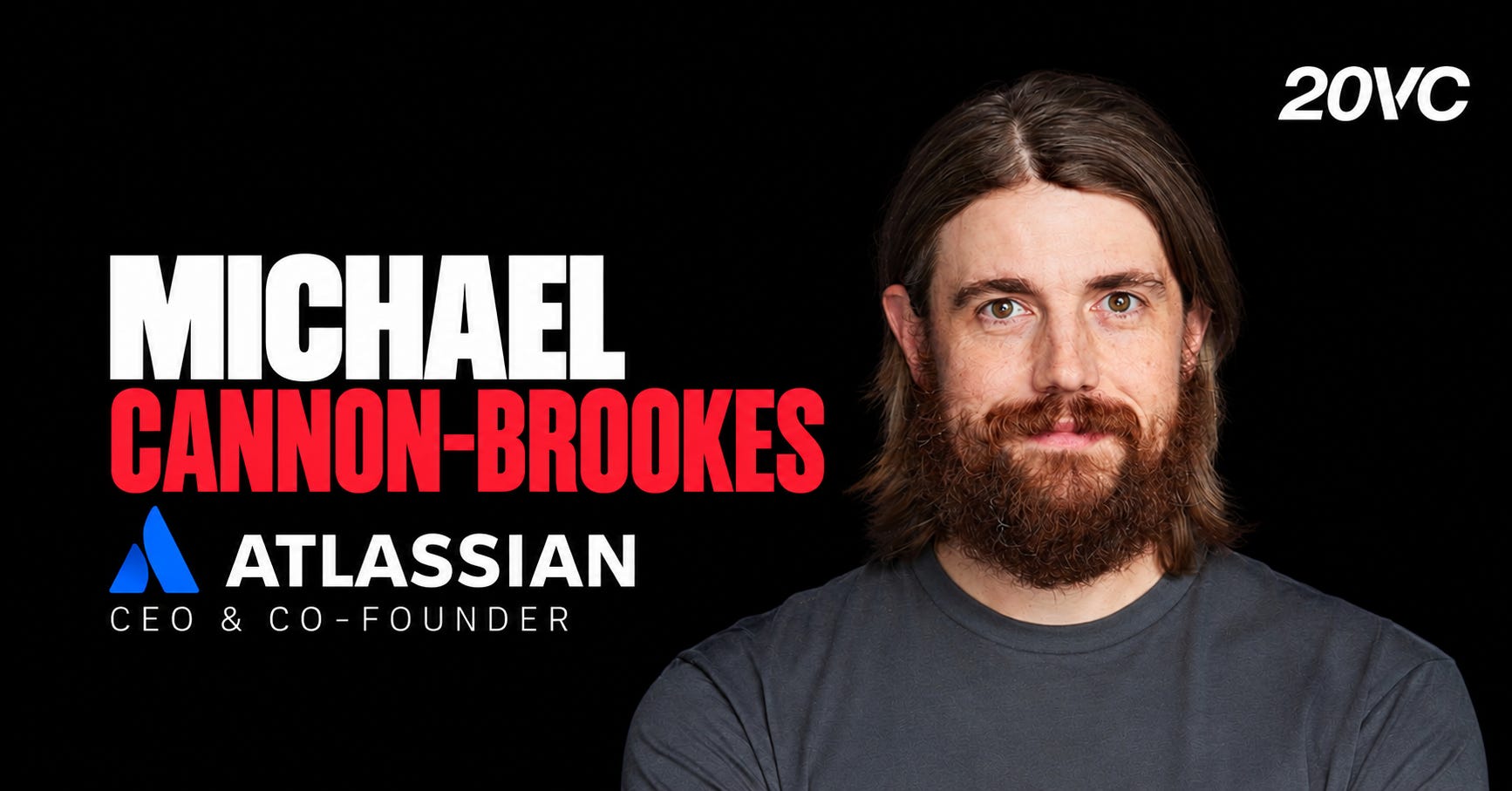
Mike Cannon-Brookes co-founded Atlassian 24 years ago and, in his mid-40s, still runs it as CEO. The company behind Jira, Confluence, Trello and Loom generated $6.5 billion in ARR in 2026 and serves more than 350,000 customers. His co-founder, Scott Farquhar, has since retired, and Cannon-Brookes is leading Atlassian into enterprise AI through Rovo and the Teamwork Graph. Speaking from Amsterdam, where Atlassian was announcing new features, he argues that agents raise the stakes on design instead of erasing it, explains why Atlassian keeps Chinese models out of production, and says inference will get cheaper than he expected. These signals are from an interview that Harry Stebbings did with Mike Cannon-Brookes on the 20VC podcast.
The Screen Survives
Don’t Give Away the Screen. Agents will take over purely functional tasks, Cannon-Brookes says, the way you just want a charging cable without browsing for one. Collaborative work, full of taste and judgment, is different. So he stands by his line: giving up on your interface is a brainless bet. That isn’t a stance against agents. Atlassian runs one of the top MCP servers in the world, he says, and agents reading its Teamwork Graph show off how good that data is. → 3:43
Today’s Great App Is Tomorrow’s Also-Ran. It is easy to build an app that beats 90% of what’s out there today, Cannon-Brookes says, but in 5 years the same app will beat only 20%. Standards keep rising, and keeping up takes R&D and hard craft work. Atlassian is investing in design more than it ever has. His reasoning: when creating technology becomes cheap and abundant, design and experience are what make a product stand out. → 5:32
Forget the Super-Agent. Cannon-Brookes expects horizontal agents, deep vertical agents and human interfaces to coexist. In Confluence, you can highlight a number and have it checked against Databricks or Snowflake through the Teamwork Graph, but that doesn’t make Confluence a BI tool. Figma’s agent works inside Atlassian, and Atlassian’s works inside Figma. He calls himself a big bear on the magic-button thesis, the idea that one button will eventually do everything for us. → 8:32
Designing for Agents
The Blank Box Problem. For the first time since mobile, Cannon-Brookes says, his design team is solving foundational problems. The first is the prompt box: a blank line with unlimited power behind it, which he calls a terrible interface. Most users stare at it and treat it like Google search. The open questions are how agents should appear in a collaboration tool, how to surface their power at the right moment, and how humans and agents should work side by side. → 9:08
Did You Write This, or Did Codex? When Codex opens a pull request, Cannon-Brookes asks, did Harry do it, did Codex do it, or was it Codex on Harry’s behalf? Answering that is now a design problem. He pushes back on watermarking, like Anthropic’s, that implies AI text is bad. A 3,000-word essay generated from one line and your own essay polished by AI can carry the same mark. Nobody needs every agent trace, but people need to understand them. → 11:38
Models and Money
Open, Yes. Chinese, Not Yet. Stebbings relays Jason Lemkin’s view that enterprises won’t touch Chinese open models. Cannon-Brookes is more precise: some customers push back on Chinese models, but none push back on open ones. Atlassian runs Nvidia’s Nemotron and Mistral, and no Chinese models in production. His job is to apply the best model to each job, not to pick one. Long term, he thinks refusing a cheaper, better model whose contents you can inspect will be a hard choice to defend. → 17:51
Your “Own Model” Is Probably Someone Else’s. The jury is still out on specialized models, Cannon-Brookes says. They make sense with deep proprietary data or truly specialized uses like robotics. But when a company announces its own model with a quirky name, it is usually a Chinese open-weight model with fine-tuning on top. When someone claims they trained one for a million dollars, his response is that they tailored someone else’s billion-dollar model. Atlassian fine-tunes open-weight models too, and doesn’t call them its own. → 21:51
Easy Money Skips the Cost Lesson. Cannon-Brookes jokes that he loves well-funded private companies that ignore cost, because they aren’t building the discipline. Getting good results from an expensive model is easy. Getting them from a cheaper or older one is a real advantage. Large enterprises are now highly sensitive to price performance, and Atlassian ships products that show customers their token spend. He thinks managing technology cost will be a defining trait of great tech companies. → 26:28
Don’t Count Pennies at Five Users. Atlassian routes its AI calls internally, through what Cannon-Brookes calls a sizable AI gateway team that balances quality, price and speed for each feature. But he tells product teams not to optimize cost too early. Build magical features first. If five people use a feature, he doesn’t care what it costs. If 5 million do, he cares a lot, and there is usually time in between to bring the cost down. → 31:25
Inference Prices Will Fall Off a Cliff. Asked what is expensive today and won’t be in 5 years, Cannon-Brookes picks model inference. The capital and talent pouring into price-per-watt performance, from people who might otherwise have joined McKinsey or NASA, is enormous. New chips, better data centers and distillation take years to land, but he expects costs to fall at a precipitous rate, even as usage explodes. It is also what he has changed his mind on most this year: prices will fall further than he thought. → 32:17
Where the Edge Moves
Imagination Is the New Inside Information. Right now, Cannon-Brookes says, the production of technology is outrunning its consumption. Atlassian can ship features faster than customers can absorb them. He borrows a phrase from Culture Amp founder Didier Elzinga: the world is moving from information asymmetry to imagination asymmetry. Knowing something others don’t matters less. The edge goes to whoever imagines new ways to apply AI to a problem. For first-principles thinkers, he calls it the most exciting period tech has ever had. → 33:53
Your Org Chart Expires Every Day. Plenty of company data never reaches a database, Cannon-Brookes says; it lives in PowerPoint slides. The Teamwork Graph pulls decisions, documents and code into a map of who works with whom, then infers answers before an agent asks, the way Google indexes the web in advance. That map is only valid today, because people join and leave. Knowing he wrote Java in 2003 is useless. Knowing he was once a programmer still helps. Facts must be fresh; lessons can be old. → 39:37
Anyone Can Write a Doc. By Atlassian’s last disclosed figure, Confluence alone is past $1.5 billion in ARR and growing more than 25% a year, big enough to be a public company. Yet there are probably 20 ways on your computer to write down a piece of text. Writing alone is no advantage, he says. What wins is design, experience, purpose and integration into other workflows. That is his answer to OpenAI and Anthropic, both Atlassian partners, moving into documents. → 45:50
The Long Game
Money Won’t Keep You Going. Stebbings worries that young founders are cashing out too fast. Cannon-Brookes, 24 years into Atlassian, says founders have to understand where their energy comes from, the same lesson he wants his kids to learn. Few people stay motivated by money or status for 5 to 10 years. Every tech wave, from mobile onward, pulls in capital and people who don’t stay. His own energy comes from working with smart people on hard problems. → 50:52
Slow Down to Go Fast. The best advice Cannon-Brookes has received is “wage peace on yourself,” because people in tech hold themselves to incredibly high bars. The skill he most needs to build is slowness. Agents make it even easier to stay busy, and the day-to-day churn hides the year-to-year shifts. He has been carving out a couple of hours a week for long, deep thinking. His rule for a world that keeps speeding up: slow down to go fast. → 56:56
Watch the full video at
.