


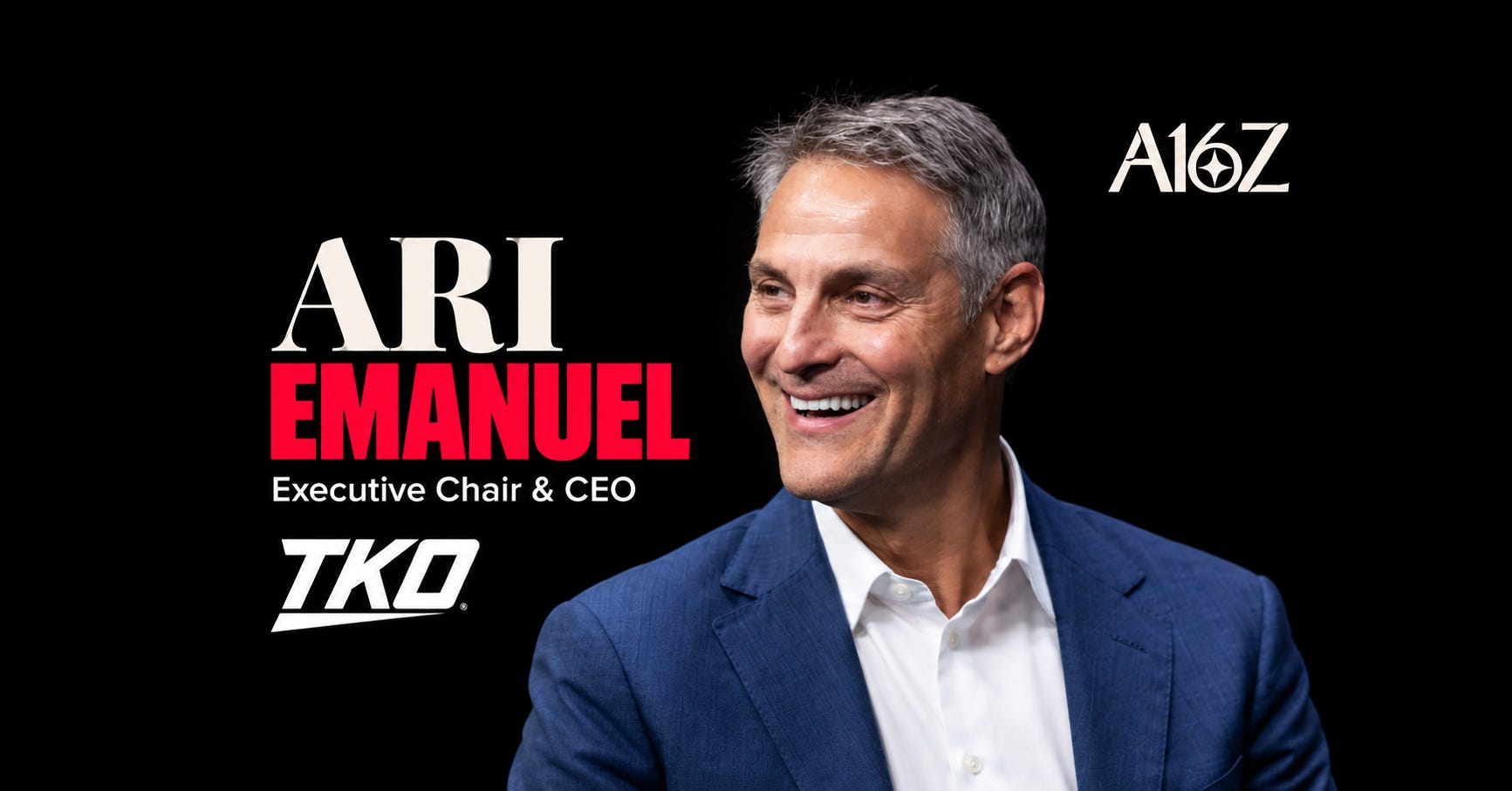
Ari Emanuel started Endeavor in 1995 with 3 partners, a table and a phone, after leaving ICM. He later merged it with William Morris, an agency about 100 years old. With Egon Durban he bought IMG for $2.4 billion and the UFC for $4.2 billion, a deal people called the most expensive in sports history. Today he runs TKO, a pure sports business, and MARI, a new live events company he started with Mark Shapiro. He is dyslexic, spent decades fearing he would be found out, and his book opens with the word rage. He talks through the deals, the calls and how he outgrew the rage with David Senra. These signals are from an interview that David Senra did with Ari Emanuel on the David Senra podcast.
The Bet
1. Create Serendipity. Emanuel’s partnership with Egon Durban started with an article. While raising money for Raine, the merchant bank he started with Joe Ravitch and Jeff Sine, he read a Marc Andreessen article, met him and asked him to invest. Andreessen agreed to do it alongside Durban. After IMG’s owner, Ted Forstmann, died, Durban asked to buy a piece of Emanuel’s company and go after IMG. He came back 3 weeks later with an offer Emanuel could have signed as is. Emanuel calls this creating serendipity. ↗ 3:42
2. Own a Piece of the Game. Emanuel, Mark Shapiro and Brent Richards pitched Durban a bigger idea. IMG had added events, sports, production and licensing to the agency’s movies, TV, music, theater and books. Because they already negotiated sports, film and TV rights with networks worldwide, they should put ownership on top and own something in sports. Their reasoning: streaming would move toward ad-supported tiers, and sports keeps people engaged. About 2 years later, the UFC came up for sale. ↗ 6:45
3. It Starts With a Four. As Senra retells it from the book, Emanuel asked Lorenzo Fertitta to close his eyes and name the number that would make him happy. The answer started with a 4. “I just needed the framing,” Emanuel says. He had worked with the company for 20 years and knew how much Fox needed it. The $4.2 billion deal was pieced together through the Brexit turmoil, with Michael Dell taking the preferred and KKR’s founders backing them, and the stress made Emanuel physically sick. ↗ 8:00
The Rights
4. Walk Out With the Number. After the deal closed, the expected TV buyers vanished. Rupert Murdoch sold Fox’s assets to Disney, the AT&T deal slowed, and Amazon’s offer fell from about $260 million to about $140 million. Then ESPN’s Kevin Mayer called. Mid-pitch with Bob Bakish at Viacom, Emanuel got a WhatsApp from Mayer agreeing to their price, $300 million. He slid the phone to Shapiro and ended the meeting. It was the deal he wanted, with 4 months left before it became a nightmare. ↗ 10:33
5. Hold Out for 10. The ESPN deal put 8 episodes on ESPN and the rest on ESPN+. Dana White refused unless it was 10. Emanuel had no other buyer, but called Mayer anyway and argued ESPN needed 10 to build stars and sell its paywall. Bob Iger told Jimmy Pitaro to give him the 10. Emanuel then pushed ESPN to take the pay-per-views as well, and it did, in a 7-year deal he puts at almost $4 billion, close to the UFC’s purchase price. ↗ 17:17
The Merger
6. The 4-Year Merger. When Endeavor first approached William Morris in 2003, its executives laughed. Emanuel says he blew that meeting by going crazy and pushed the merger back 4 years: “I played a horrible game of chess.” In those years he and his partner Patrick stole clients and agents, weakening the older agency, and listened for trouble. When a senior William Morris agent approached him at a holiday event, talks restarted and moved in about 6 months. The dissent inside, he says, let them be the conquerors. ↗ 24:00
7. $44 Million to Close. Even after both sides voted yes, senior William Morris equity holders warned the merger would not work. Emanuel met separately with 2 big earners who disliked its leadership, Peter Grosslight in music and Mark Itkin in non-scripted, and brought them into the plan. Endeavor then paid $24 million to buy out Jim Wiatt and $20 million more for another executive who lacked two-thirds board support, in the middle of the 2008-09 crisis. Emanuel calls it the greatest deal he and Patrick ever did, by far. ↗ 26:02
8. The No-Collateral Loan. Endeavor began when Emanuel, Tom Strickler, Rick Rosen and David Greenblatt left ICM with a table and a phone. ICM sued, their commissions sat in escrow and none of them had money. Russell Goldsmith at City National backed them with $1 million and no collateral, then backed them again in 2009. Years later, Goldsmith was selling City National and asked for some of the IMG deal’s bonds. Emanuel asked Durban for $300 million worth, repaying a debt he had promised to settle someday. ↗ 30:02
The Playbook
9. You Won’t Remember $400 Million. In the IMG auction, a rival bid about $1.9 billion. Durban pushed Emanuel to offer $2.3 billion to $2.4 billion and take the deal off the table in one swoop, so no one could bid them up. His line about the extra $400 million: “You’re never going to remember it.” Senra notes that Emanuel has since used it on his own deals. Even with the right strategy, Emanuel says, the road will be bumpy, and saving $100 million or $200 million is not the game. ↗ 32:32
10. Get in Traffic. Emanuel was nervous about merging with William Morris, and David Geffen, an adviser and mentor, told him to “just merge with William Morris, get in traffic and get hit.” Geffen cuts through a business in a line or two, Emanuel says, and does not listen to the voice in his head. Emanuel admits he should have listened much earlier. His reading of the advice: you will work harder than anybody, there will be good and bad, and you will survive. ↗ 39:21
11. Roll the Calls. Walking into the office or getting into his car, Emanuel tells his assistant to roll the calls. He reads about someone, calls them and keeps calling until they call back, using humor and self-deprecation so it does not feel like stalking. Around 1992 he read George Gilder’s Life After Television and called him. That led to Endeavor’s founding thesis in 1995: distribution would change, and content creators would become more valuable. He met Elon Musk the same way, after reading about his car company. ↗ 45:19
12. Live Can’t Be Replaced. Musk was talking about AI in 2007, Emanuel says, and told him sports would matter. His other point was that live entertainment is the one thing AI cannot disintermediate. That became the idea behind MARI, which sits beside TKO’s pure sports business. MARI’s assets include the Miami Open and Madrid Open in tennis, Escape from Alcatraz, Frieze, Barrett-Jackson and Collectcon in the Pokémon space, and it aims to cover live events globally. ↗ 51:58
The Character
13. Rage Has a Ceiling. Getting hit by a car at 32 taught Emanuel that life is not a dress rehearsal. Over time he concluded that rage and anger would never get him to really big heights. He was not enjoying his life, and he saw the toll it took on his marriage. Jeff Bezos once told him to be fully on the field and fully off it when he leaves, because time off the field makes you more potent on it. ↗ 1:00:23
14. Forget the Legacy. In 2022, after his brother Zeke told him it could not kill him, Emanuel tried 5-MeO-DMT in New Mexico. He says it showed him how small we are and helped with what his therapist calls the ego project. His conclusion: legacy does not matter. Almost nobody knows that the most important businessman of 1953 was Alfred Sloan of GM. Senra raises Marc Andreessen’s worry that psychedelics make founders work less, and Emanuel dismisses it. ↗ 1:10:10
15. Entourage Opened Doors. Emanuel represented Mark Wahlberg, whose crew inspired Entourage, and he expected the show to hurt his career. Wahlberg and his manager, Stephen Levinson, told him it would be the greatest thing that ever happened to him. Afterward, Emanuel says, he could get anybody on the phone, and the pieces of his puzzles got easier to put together. Senra’s version: there is no such thing as a cold meeting anymore. ↗ 1:18:16
Watch the full video at
.